常见问题
常见问题  登入成功
登入成功 
Accounting & Finance Finance and Compliance
Postgraduate Diploma in Finance and Law
財務及法律深造文憑

The Postgraduate Diploma, commonly referred to as a “研究生文凭” in Mainland China, is a qualification awarded by higher education institutions in former Commonwealth countries or regions (such as the United Kingdom, Canada, Australia, New Zealand, Singapore, Ireland, and Hong Kong SAR). It represents a higher level of study pursued after obtaining a bachelor’s degree.
Generally speaking, Master’s degree programmes emphasise academic scholarship, while Postgraduate Diploma programmes (or “研究生文凭” as commonly known in Mainland China) focus on developing professional application skills. Postgraduate Diplomas carry academic credits, and holders may apply for credit exemptions when enrolling in programmes in other countries or regions (if applicable). However, the extent of credit exemption depends on various factors and is ultimately determined by the university offering the programme.
Postgraduate programmes require students from outside Hong Kong to apply for a study visa before the course starts. For full details, please visit the Study Visa page. For details about the possibility to stay and work in Hong Kong after graduating from a full-time postgraduate programme, please visit the IANG Visa page.
12 months full-time study in Hong Kong to get your “Postgraduate Diploma in Finance and Law” award within the HKU system through HKU SPACE.
Applicants with other English-language qualifications may also be eligible for admission. Please contact the programme team for advice.
The revised total number of credits is 120 (Subject to approval).
This programme is subject to approval.
Programme Overview
Highlights
Postgraduate Diploma in Finance and Law is designed to give you a sophisticated understanding of the legal and regulatory framework for the local and international financial sector, by taking an integrated approach to finance and law. Financial institutions need leaders who have extensive knowledge relating to the legal issues in international finance and banking.
This PGDFL creates a new kind of financial services professional: graduates who are trained in both finance and law. You will develop an advanced interdisciplinary understanding of relevant legal and financial contexts and combines a highly analytic academic core with applications informed by current practice.
Student Story – Graduate of 2024, (Part-time) Postgraduate Diploma in Finance and Law
- Speakers:
- Mr Kenny Ip (Retired Chief Superintendent of Police)
Programme Details
Programme Intended Learning Outcomes
- On completion of the programme, students should be able to
- Apply a systematic coherent body of knowledge in finance and corporate law to evaluate financial risks and investments;
- Apply knowledge, skills and practices used in financial services and corporate laws to adopt corporate governance, meet compliance standards and practice corporate social responsibility for the community;
- Exercise appropriate judgments in decision making in investments, corporate financing and financial risk management; and
- Evaluate a wide range of numerical and graphical data in financial analysis, investments and corporate risk assessment and management
- Critically evaluate and apply interdisciplinary knowledge, concepts and professional skills across diverse intercultural, organisational and technological contexts, and to exercise informed judgment in addressing complex real-world issues
- Critically evaluate, integrate and apply subject knowledge and appropriate methodologies in the planning and execution of a significant project, and to communicate evidence-based findings, conclusions and recommendations in an academic/professional manner
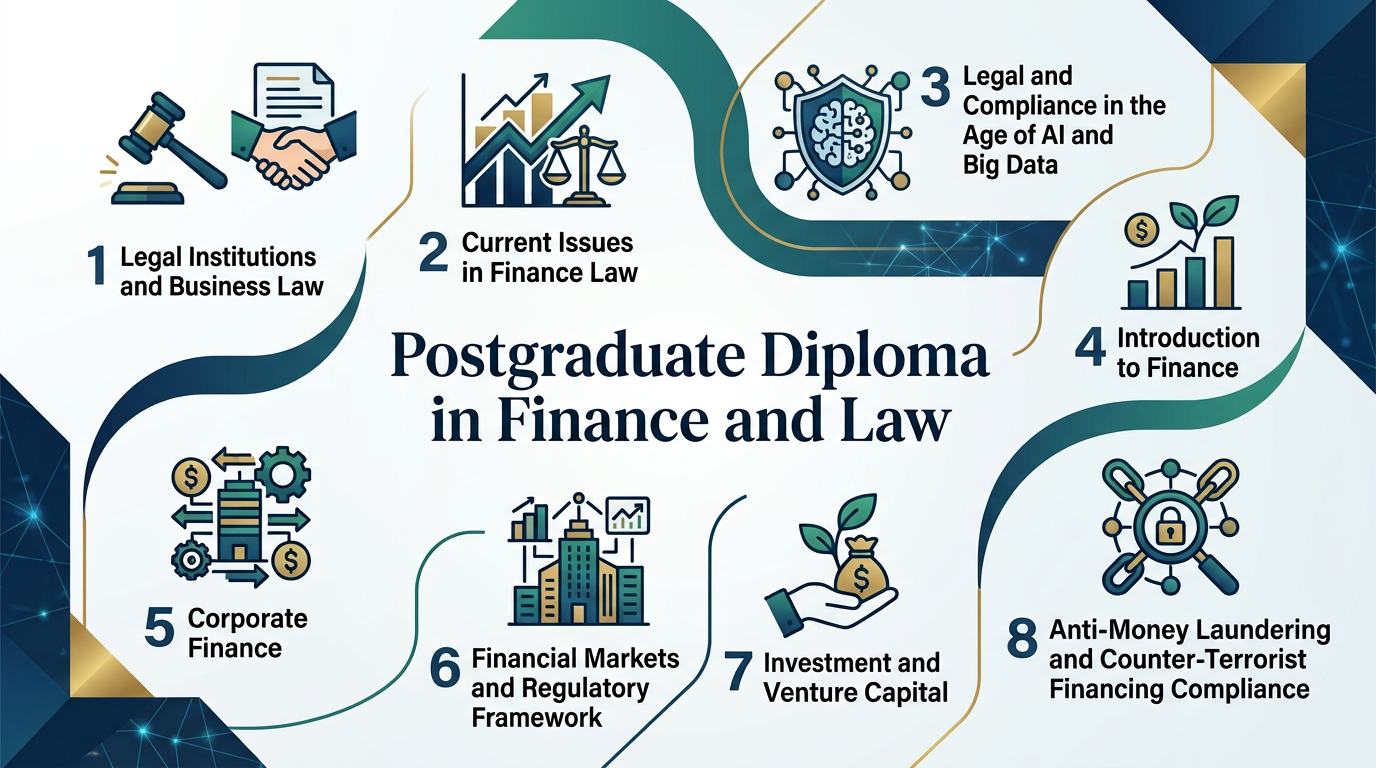
Programme Structure
| Module | |
|---|---|
| Law Stream (choose 2 modules) | |
| 1 | Legal Institutions and Business Law |
| 2 | Legal and Compliance in the Age of Artificial Intelligence (AI) and Big Data |
| 3 | Current Issues in Finance Law |
| Finance Stream (choose 3 modules) | |
| 4 | Introduction to Finance |
| 5 | Corporate Finance |
| 6 | Financial Markets and Regulatory Framework |
| 7 | Investment and Venture Capital |
| 8 |
Anti-Money Laundering and Counter-Terrorist Financing Compliance |
| *9 | Executive Leadership Development |
| *10 | Intercultural Communication – Trilingualism and Hong Kong Culture |
| *11 | Intelligent Technologies for ESG Integration and Sustainable Development |
| *12 | Capstone Project |
Students have to study two Law modules from modules 1, 2 & 3 and three Finance modules from modules 4, 5, 6, 7 & 8)
* Subject to Approval
Programme Specific Activities
During the study period, students will have the opportunity to participate in programme-specific activities such as field trips and career talks, all tailored to their individual needs. These activities are designed to foster stronger connections with the industry and provide students with invaluable hands-on experiences in the real business world. This exposure will not only help students set goals that align with their interests and aspirations but also facilitate their future career plans, ensuring they are well-prepared for their professional journeys.
Assessment method
| Type of Assessment | Weighting |
|---|---|
| Continuous assessment | 30% |
| Examination | 70% |
| Total: 100% |
Award
Upon successful completion of the programme, students who have passed the assessment with attendance of no less than 70% for a total of 5 modules, with 2 modules from the law stream, plus 3 further modules chosen from the finance stream, will be awarded the Postgraduate Diploma in Finance and Law
within the HKU system through HKU SPACE.
| Application Code | 2465-FN170A | Apply Online Now |
| Apply Online Now | ||
Modules & Class Details
Modules
- Sources of law
- Definition of Law
- Civil and Criminal Law
- Various sources of Hong Kong Law
- Finding and Citing Sources of Law
- Importance of various sources of law within the structure of the Hong Kong Legal system
- Legal System of Hong Kong
- Courts and Tribunals
- Personnel, Powers and Jurisdiction
- Legal reasoning and precedent doctrine
- Theory of Doctrine of Judicial Precedent
- Operation of judicial precedent within the hierarchy of the court structure in Hong Kong
- Binding Precedents
- Persuasive Precedent
- Setting up business entities, agency and partnership law
- Main types of business media/organisation in Hong Kong
- Agency Law and Partnership Law
- Other business relationships
- Risk and Legal factors in setting up business in Hong Kong
- Fundamentals of Contract Law
- Elements of Contracts and their Essential features
- Vitiating factors
- Breach of contract
- Remedies
- Tort of Negligence
- Tort Law
- Examples of Torts and the development of negligence in particular
- General principles of Tort Liability and Vicarious liability
- Negligence, Duty of care, Breach of Duty and Causation,
- Statutory Torts, Nuisance
- Defences - Remedies and Risk Management
- Law in Capitalization, financing, capital re-construction and liquidation
- Aspects of Law in Capitalisation, Raising Capital and allotment of shares
- Company / Corporation Law
- Duties of Directors
- Corporate Insolvency and Winding up
- Liquidation, Winding up by Court, Voluntary Winding Up
- Introduction to AI and Big Data
- Overview of AI and big data technologies
- Applications in Hong Kong
- Legal and compliance implications
- Regulatory Framework for AI in Hong Kong
- Laws and regulations governing AI
- Data protection and privacy laws
- Intellectual property considerations
- Global AI regulatory landscape
- Regulatory Framework for Big Data in Hong Kong
- Legal landscape for big data
- Compliance requirements
- Case studies on regulatory challenges
- Ethical Considerations in AI and Big Data
- Ethical implications of AI and big data
- Bias and fairness in AI algorithms
- Privacy and data protection ethics
- Implications for businesses and society in Hong Kong
- Compliance Challenges in AI Applications
- Compliance requirements for AI projects
- Risk management strategies
- Ensuring transparency and accountability
- Compliance Challenges in Big Data Applications
- Compliance considerations for big data projects
- Data governance and security
- Compliance monitoring and reporting
- Data Protection and Privacy Regulations
- Data protection laws in Hong Kong
- Compliance with privacy regulations
- Data governance best practices
- Cross-border compliance challenges
- AI Governance and Accountability
- Governance frameworks for AI
- Accountability in AI decision-making
- Ensuring ethical AI practices
- International standards and best practices
- Intellectual Property Issues in AI and Big Data
- IP considerations in AI and big data projects
- Ownership of AI-generated content
- IP protection strategies
- Case studies on sector-specific compliance issues
- International perspectives on AI regulation
- Regulatory environments and role of regulators e.g. Australia royal commission, HKMA, MAS)
- Corporate governance, corporate culture and whistleblowing e.g. Barclays whistleblower, Tipper X)
- Financial crime, money laundering, fraud, sanctioned countries e.g. China IPOs, 1MDB)
- The power of information (confidentiality, banking secrecy, personal data (incl EU directive), info security, market manipulation e.g. JP Morgan princelings, LIBOR, rogue traders)
- Fintech (digital banking, crypto currency, bitcoin etc.)
- Conflict of interest, suitability, mis-selling, KYC, cross border, AEI, US Person, remuneration of bankers.
- The role of banks, pawnbroking, shadow banking, crowd funding, shariah financing.
- Finance and The Finance Systems
- Introduction to Finance
- Financial Statement and Cash Flow
- Financial Analysis
- Financial Statement Analysis
- Ratio Analysis
- Concept of Time Value of Money, Annuity and Perpetuities
- Future Value and Present Value
- Compounding and Discounting
- Annual Percentage Rate and Equivalent Annual Rate
- Annuity and Perpetuities
- Interest Rates and Bond Valuation
- Bond Concepts
- Bond Valuation
- Equity Markets and Stock Valuation
- The Present Value of Common Stocks
- The Dividend Growth Model
- Cost of Capital
- Cost of Debt, Preferred Stock, and Common Equity
- Weighted Average Cost of Capital
- Investment Appraisal – Capital Budgeting
- Net Present Value and Other Investment Rules
- Sensitivity and Scenario Analysis
- Risk and Portfolio Management
- Expected Return, Variance and Covariance
- The Return and Risk for Portfolios
- The Efficient Frontier
- Diversification
- Relationship between Risk and Expected Return (CAPM)
- Efficiency of Capital Market
- Weak, Semi-strong and Strong Forms of Efficiency
- Anomalies: Bubbles and Market Crashes
- Corporate Finance and Role of Financial Management
- Core Theories of Corporate Finance
- Key Questions in Corporate Finance
- The Objective of the Firm
- Agency Problems
- Investment Principles and Capital Budgeting Decisions
- Investment Principles and Net Present Value
- Capital Budgeting Techniques
- Value of Abandonment Option
- Choice of Capital Structure
- The Debt-Equity Irrelevance Theorem
- Corporate and persona Taxes
- Effects of Bankruptcy Costs
- Trade-off Theory of Optimal Capital Structure
- Information Asymmetries and Agency Cost
- Asymmetric Information Explanations of Capital Structure
- Minimising the Agency Costs of Equity and Debt
- Dividend Policy
- Empirical Evidence on Dividend Policy
- The Irrelevance of Dividend Policy
- Tax Implication for Dividend Policy
- Asymmetric Information, Signalling and Agency Cost
- Mergers and Acquisitions
- Forms of Takeover
- Some Stylised Facts about Merger Activity
- Motives for Merger
- Takeover Defense Mechanisms
- Regulation
- Target Company Valuation
- Long-term Financing
- Issuing Securities to the Public
- Long-Term Debt
- Leasing
- Options, Futures and Corporate Finance
- Option
- Future
- Types of financial markets
- money market
- capital market
- equity market
- foreign exchange market
- Financial institutions/markets in Hong Kong
- structure
- role and mechanism
- Types of financial instruments
- securities
- options
- futures and hedge funds
- Regulatory framework
- overview of regulation of Hong Kong financial industry
- Scope of Securities and Futures Commission Ordinance (SFO)
- role and function of Securities and Futures Commission (SFC)
- regulation, licensing, registration and administration functions of SFC
- Hong Kong Securities Institute (HKSI)
- Hong Kong Exchange (HKEx)
- Hong Kong Banking Ordinance and Hong Kong Monetary Authority (HKMA)
- role of HKMA in supervision of Hong Kong banking institutions
- international banking standards and Basel capital accords
- principles of relevant banking laws and the Companies Ordinance
- Market Misconduct
- Market Misconduct Tribunal
- improper trading practices, disclosure standards and compliance
- social responsibility and ethical issues
- Future development of the Hong Kong financial markets
- Overview of Alternative Investments
- Investment Companies
- Private Equity
- Private Equity and Venture Capital
- An Overview of the Venture Capital Market
- The Organisation of Venture Capital Firms
- Role of Venture Capitalist and types of Venture Capital
- How Venture Capitalists Add Value
- Investment Selection and Venture Capitalist Compensation
- Venture Capital Contracts with Portfolio Companies
- Venture Capital Contracts with Investors
- Business Planning
- Business Plan of New Ventures
- Due Diligence
- Fund Raising
- Venture Capital Fund Operations
- How are Venture Partnerships Structured
- Deal structuring
- Term Sheets
- Investing
- Why are Investments staged
- An Overview of Valuation techniques
- Valuation in Practice: The Investor’s Perspective
- Post Investment Management
- How do Venture Capitalists Oversee Firm
- Why do Venture Capitalists Syndicate Investments
- Exiting
- Potential Exit Strategies
- Going Public, Acquisition and Management Buy-out
- New Frontier
- Recent Development in Private Equity
- Recent Development in Venture Capital
- Other types of Alternative Investments
- Hedged funds
- Real estate
- Mortgage-backed securities
- Elements of Anti-Money Laundering compliance
- Internal policies, procedures and controls
- Training in compliance
- Internal audit
- Compliance culture and senior management’s role
- Customer Due Diligence implementation
- Building an effective Anti-Money Laundering and Counter-Terrorist Financing (AML/CTF) risk management system
- Essential elements of an effective risk management system
- Development of key risk indicators for AML/CTF and sanctions risk monitoring
- Making use of financial intelligence from internal and external sources
- Tracking regulatory changes, identifying gaps or vulnerabilities and on-going quality assurance
- Managing risk across bank groups
- Suspicious Transaction Monitoring and Reporting
- Suspicious customer behaviour and identification
- Suspicious cash transactions, non-cash deposits and wire transfer transactions
- Suspicious commercial account activity and credit transactions
- Suspicious investment trade
- Suspicious activity in currency exchange centres
- Application of the risk-based approach
- Formulating a tailored risk-based approach
- Implementing the risk-based approach
- Risk identification, assessment and mitigation
- Internal controls, monitoring and governance
- Customer due diligence requirements in cross-border context
- Managing high risk situations and relationships
- Handling and reporting of suspicious transactions
- Post-reporting measures
- Law Enforcement Investigations
- Decision to prosecute
- Summonses and subpoenas
- Search warrants
- Dealing with investigators and prosecutors
- Managing stakeholders effectively
- The balance of risk and responsibility between management, business and compliance
- Personal liability and institutional liability
- Sharing of data – inter-bank data sharing, sharing information with regulator
Articulation Pathways
Career Path
- There is a collaboration agreement with the School of Law, the University of Melbourne, to provide the opportunity for students of law-related postgraduate diploma programmes to apply for the Single Subject Study Abroad, and upon successful completion of the Single Subject Study Abroad: (i) the exemption granted / awarded credit towards this programme after completion of Single Subject Study Abroad shall be subject to mapping between the relevant module of this programme and the subject of the master programmes of School of Law at University of Melbourne and (ii) be eligible to apply for admission into the Melbourne Course with advanced standing. Students with outstanding academic results will be eligible to study the Module in the School of Law at the University of Melbourne as exchange students.
- Master of Commercial Law;
- Master of Public and International Law;
- Master of Human Rights Law;
- Master of Banking and Finance Law;
- Master of Construction Law;
- Master of Global Competition and Consumer Law
Fee & Entry Requirements
Fee
HK$600 (Non-refundable)
Course Fee- HK$155,000 (Subject to approval)
Entry Requirements
Applicants shall hold a bachelor’s degree awarded by a recognized institution.
- If the degree or equivalent qualification is from an institution where the language of teaching and assessment is not English, applicants shall provide evidence of English proficiency, such as:
- an overall band of 6.0 or above with no subtests lower than 5.5 in the IELTS; or
- a score of 550 or above in the paper-based TOEFL, or a score of 213 or above in the computer-based TOEFL, or a score of 80 or above in the internet-based TOEFL; or
- HKALE Use of English at Grade E or above; or
- HKDSE Examination English Language at Level 3 or above; or
- equivalent qualifications.
Applicants who hold the Advanced Diploma for Legal Executives (Graduate Level) awarded within the HKU system through HKU SPACE would be eligible for entry.
Applicants with relevant professional qualifications or other qualifications will be considered on individual merit.
Apply
Online Application Apply Now
Application Form Download Application Form
Enrolment MethodOnline Enrolment
HKU SPACE provides 24-hour online application and payment service for students to apply to selected award-bearing programmes and to enrol in most open admission courses (courses enrolled on a first come, first served basis) via the Internet. Applicants may settle the payment by using either "PPS by Internet" (not available via mobile phones), VISA or Mastercard online. Online WeChat Pay, Online AliPay and Faster Payment System (FPS) are also available for continuing enrolment in the same programme, if online service is offered.
For first time enrolment
-
Complete the online application form
Applicant may click the icon
 on the top right-hand corner of the programme/course webpage to make online application, and then follow the instructions to fill in the online application form.
Some programmes/courses may admit by selection, and may require applicants to provide electronic copy of any required documents (e.g. proof of qualification) as indicated on the programme/course webpage. Only file format in doc, docx, jpg and pdf are supported. -
Make Online Payment
Pay the application or programme/course fees by either using:
"PPS by Internet" - You will need a PPS account and a PPS Internet password. For information on how to open a PPS account and how to set up a PPS Internet password, please visit http://www.ppshk.com.
*Credit Card Online Payment - Course fees can be paid by VISA or Mastercard including the “HKU SPACE Mastercard”.
* HKU SPACE Mastercard cardholders who wish to enjoy 10-month interest free instalment scheme must pay their tuition fees in person at any of our HKU SPACE Enrolment Centres.
To know more about first-time online application/enrolment and payment, please refer to the user guide of Online Application / Enrolment and Payment:
For continuing enrolment in the same programme
Selected programmes offer online continuing enrolment service. Programme staff will inform students if they offer this service and offer further enrolment details.
Online Payment can be made via "PPS by Internet" (not available via mobile phones), VISA or Mastercard, Online WeChat Pay, Online AliPay and Faster Payment System (FPS)
In Person / Mail
For first time enrolment
-
For first come, first served short courses, complete the Application for Enrolment Form SF26 and bring or post the completed form(s), together with the appropriate application/course fee(s) and any required supporting documents to any of the HKU SPACE enrolment centres.
[Download Enrolment Form SF26] -
Award-bearing and professional courses may require other information. Forms are usually available at the enrolment centres or on request from programme staff. Bring or post the completed form(s), together with the appropriate application/course fee(s) and any required supporting documents to any of the HKU SPACE enrolment centres.
For continuing enrolment in the same programme
-
The standard ‘Enrolment/Payment Slip’ is designed for students of award-bearing programmes or remaining programmes in a suite of programmes requiring continuing enrolment and it applies to most programmes.
-
Students should complete the “Enrolment/Payment Slip” which will be made available by relevant programme staff and return the slip to any HKU SPACE enrolment centre or post it to the relevant programme staff with appropriate fee payment.
Please refer to available Payment Methods for fee payment information. If you are in doubt about the procedures, please check the individual course details, or contact our programme staff or enrolment centres.
Please note the followings for programme/course enrollment:
- To make an application online, you will need a computer with connection to the Internet and a web browser with JavaScript enabled. Google Chrome is recommended.
- Applicants should not leave the online application idle for more than 10 minutes. Otherwise, applicants must restart the application process.
- Only Early Bird Discount is supported for Online Applicants (Application). To enjoy other types of discount, please visit one of our enrolment centres.
- During the online application process, asynchronous application and payment submission may occur. Successful payment may not guarantee successful application. In case of unsuccessful submission, our programme staff will contact you shortly.
- Applicants are reminded that they should only apply for the same programme/course once through counter or online application.
- For online enrolment, a payment confirmation page would be displayed after payment has been made successfully. In addition, a confirmation email would also be sent to your email account. You are advised to keep your payment confirmation for future enquiries.
- Fees paid are not refundable except as statutorily provided or under very exceptional circumstances (e.g. course cancellation due to insufficient enrolment).
- If admission is by selection, the official receipt is not a guarantee that your application has been accepted. We will inform you of the result as soon as possible after the closing date for application. Unsuccessful applicants will be given a refund of programme/course fee if already paid.
Disclaimer
The School provides a platform for online services for a selected range of products it offers. While every effort is made to ensure timeliness and accuracy of information contained in this website, such information and materials are provided "as is" without express or implied warranty of any kind. In particular, no warranty or assurance regarding non-infringement, security, accuracy, fitness for a purpose or freedom from computer viruses is given in connection with such information and materials.
The School (and its respective employees and subsidiaries) is not liable for any loss or damage in connection with any online payments made by you by reason of (i) any failure, delay, interruption, suspension or restriction of the transmission of any information or message from any payment gateways of the relevant banks and/or third party merchants for processing credit/debit/smart card or other payment facilitation mechanism; (ii) any negligence, mistake, error in or omission from any information or message transmitted from the said payment gateways; (iii) any breakdown, malfunction or failure of those gateways in effecting online payment service or (iv) anything arisen out of or in connection with the said payment gateways, including but not limited to unauthorised access to or alternation of the transmission of data or any unlawful act not permitted by the law.
1. Cash, EPS, WeChat Pay Or Alipay
Course fees can be paid by cash, EPS, WeChat Pay or Alipay at any HKU SPACE Enrolment Centres.
2. Cheque Or Bank draft
Course fees can also be paid by crossed cheque or bank draft made payable to “HKU SPACE”. Please specify the programme title(s) for application and applicant’s name. You may either:
- bring the completed form(s), together with the appropriate course or application fees in the form of a cheque, and any required supporting documents to any of the HKU SPACE enrolment centres;
- or mail the above documents to any of the HKU SPACE Enrolment Centres, specifying “Course Application” on the envelope. HKU SPACE will not be responsible for any loss of personal information and payment sent by mail.
3. VISA/Mastercard
Applicants may also pay the course fee by VISA or Mastercard, including the “HKU SPACE Mastercard”, at any HKU SPACE enrolment centres. Holders of the HKU SPACE Mastercard can enjoy a 10-month interest-free instalment period for courses with a tuition fee worth a minimum of HK$2,000; however, the course applicant must also be the cardholder himself/herself. For enquiries, please contact our staff at any enrolment centres.
4. Online Payment
Online application / enrolment is offered for most open admission courses (enrolled on first come, first served basis) and selected award-bearing programmes. Application fees and course fees of these programmes/courses can be settled by using "PPS by Internet" (not available via mobile phones), VISA or Mastercard. In addition to the aforesaid online payment channels, new and continuing students of award-bearing programmes with available online service, they may also pay their course fees by Online WeChat Pay, Online Alipay or Faster Payment System (FPS). Please refer to Enrolment Methods - Online Enrolment for details.
Notes
-
If the programme/course is starting within five working days, application by post is not recommended to avoid any delays. Applicants are advised to enrol in person at HKU SPACE Enrolment Centres and avoid making cheque payment under this circumstance.
-
Fees paid are not refundable except under very exceptional circumstances (e.g. course cancellation due to insufficient enrolment), subject to the School’s discretion. In exceptional cases where a refund is approved, fees paid by cash, EPS, WeChat Pay, Alipay, cheque, FPS or PPS by Internet will be reimbursed by a cheque, and fees paid by credit card will be reimbursed to the credit card account used for payment.
- In addition to the published fees, there may be additional costs associated with individual programmes. Please refer to the relevant course brochures or direct any enquiries to the relevant programme team for details.
- Fees and places on courses cannot be transferrable from one applicant to another. Once accepted onto a course, the student may not change to another course without approval from HKU SPACE. A processing fee of HK$120 will be levied on each approved transfer.
- HKU SPACE will not be responsible for any loss of payment, receipt, or personal information sent by mail.
- For payment certification, please submit a completed form, a sufficiently stamped and self-addressed envelope, and a crossed cheque for HK$30 per copy made payable to “HKU SPACE” to any of our enrolment centres.
- More Programmes of
- Finance and Compliance Professional Law Courses